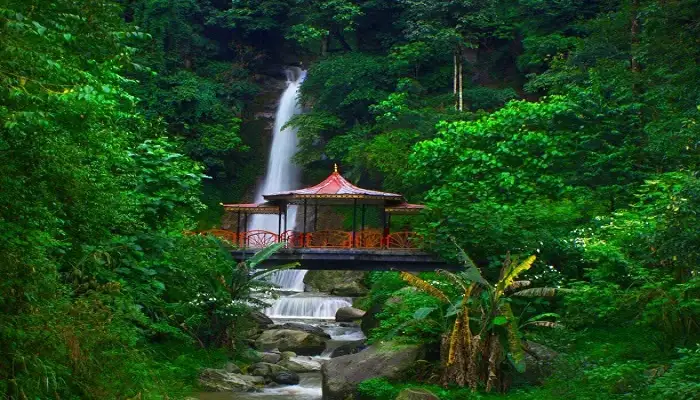
Banjhakri Falls is one of Gangtok’s most photographed and culturally evocative attractions. Located in a landscaped park a short drive from central Gangtok, the site combines natural scenery, traditional folklore and purpose-built displays to create an experience that is both recreational and educational. This article explores the history, cultural significance and tourism context of Banjhakri Falls.
The Banjhakri Falls complex is situated on a hillside amid dense rhododendron, oak and pine vegetation. The waterfall itself cascades into a pool set within a well-maintained garden and paved pathways. The park is easily visited as a half‑day excursion from Gangtok city and is often included on city sightseeing circuits.
The name Banjhakri comes from local Himalayan folklore. In the oral traditions of Sikkim and neighboring Nepal, the Banjhakri (literally “forest shaman” or “jungle shaman”) is a supernatural being associated with the training of shamans. Stories portray the Banjhakri and his female counterpart, the Banjhakrini, as forest spirits who abduct gifted children to instruct them in shamanic arts—healing, trance and communication with spirits.
These narratives are central to the cultural identity of many ethnic communities in the region. By incorporating statues and scenes from the legend, the Banjhakri Falls site makes the folklore visible to visitors and helps preserve an aspect of intangible heritage.
Over recent decades, local and state authorities developed the waterfall site into a formal park to promote eco‑tourism and cultural tourism. The objective was to create a family‑friendly attraction that showcases both natural beauty and the region’s living traditions. The design of the park intentionally blends:
Combining nature with cultural interpretation turns a simple scenic spot into a meaningful tourist destination. Visitors gain aesthetic pleasure from the falls while also leaving with an understanding of local belief systems and community heritage.
Banjhakri Falls serves multiple cultural functions:
As part of Gangtok’s tourism circuit, Banjhakri Falls attracts domestic and international visitors looking for a compact, scenic outing that requires little time or exertion. Typical visitor activities include photography, short walks, learning from the displays, picnicking and enjoying the themed sculptures.
The park contributes to the local tourism economy by creating direct and indirect employment (park staff, guides, vendors), and by increasing the length and diversity of stays in Gangtok. It also serves as an accessible cultural resource for school groups and domestic tourists who may be less able to undertake longer treks into the hills.
Maintaining a natural site that is also a tourist attraction requires careful management. Key considerations at Banjhakri Falls include:
While details such as opening hours and fees can change, these general tips help prepare a visit:
Banjhakri Falls is often visited with other Gangtok sites. Nearby points of interest commonly included on the same circuit are monasteries, viewpoints, and cultural institutions in and around Gangtok—making the falls a convenient stop within a broader cultural itinerary.
Banjhakri Falls is more than a picturesque waterfall: it is a designed cultural landscape that links natural beauty with Himalayan folklore and contemporary eco‑tourism. For travelers, it presents an easy, informative and photogenic encounter with Sikkim’s heritage. For the local community and tourism planners, it demonstrates how small, well‑managed attractions can conserve tradition, educate visitors and support sustainable local livelihoods.
Visitors interested in deeper cultural understanding should seek guided talks with local interpreters, visit nearby monasteries and museums, and explore opportunities to learn about shamanic traditions from community‑based cultural programs.
What makes us different from other tour package companies
Our travel experts have core and intense knowledge about Sikkim sector with over 10 years of experience that will help you choose the best possible itinerary as per your requirements.
Our travel experts are just one call away during your tour to help you with any kind of immediate assistance so that your tour is a more enjoyable and hassle-free tour.
eSikkimTourPackages ensures best rates to all our esteemed guests since we have our own hotels and fleet of vehicles and drivers and there is no third-party involvement. This ensures personalized service and best rates.





















Kindly enter the details below for your Sikkim Tour Package